
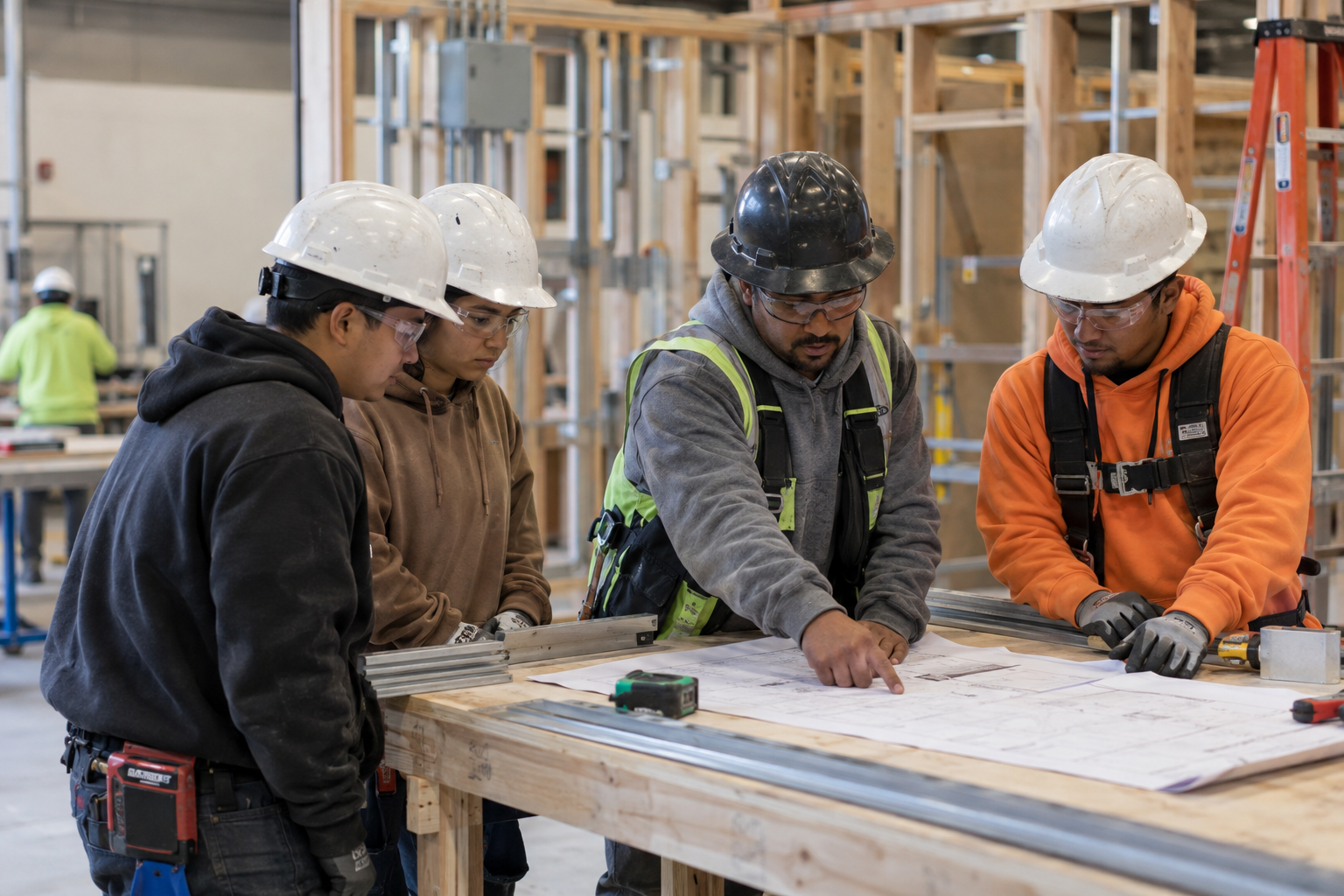
Southern California contractors face a familiar problem: open positions in the skilled trades can stay open too long, while backlogs, supervision demands, and public-works obligations keep growing. ABC SoCal workforce development offers a practical way to build workforce capacity by upskilling current employees instead of relying on recruiting alone.
That is where ABC SoCal workforce development becomes practical. Upskilling the workers already on your payroll can help expand jobsite capability faster than waiting for the perfect hire. For contractors across Orange, Los Angeles, Riverside, San Bernardino, and Ventura Counties, that can mean building stronger crews through apprenticeship, craft training, safety education, and supervisor development rather than treating every labor shortfall as a hiring problem.
This article is written for Southern California construction leaders who need a more dependable way to build workforce capacity. The goal is simple: help you think about upskilling as an operating strategy that supports production, retention, and long-term growth.
Contractors throughout the region are competing for many of the same workers. When demand is high and experienced labor is hard to find, companies that build talent internally are often in a stronger position than those that rely only on outside hiring.
That does not mean recruiting stops mattering. It means recruiting works better when it is paired with a system that develops current employees into more capable craft professionals, lead workers, and foremen. Upskilling can help reduce bottlenecks, strengthen bench depth, and give employers a clearer path to staffing future work.
Construction Executive’s recent workforce coverage has framed the issue in similar operational terms: contractors need to understand their workforce limits before project pressure exposes them. That logic fits Southern California well, where project opportunities and labor constraints often rise at the same time.
For merit shop contractors, workforce development is most useful when it connects directly to field performance. ABC SoCal supports that kind of approach through training pathways that help employers build skills, reinforce safety expectations, and create clearer advancement tracks for workers.
Depending on the employer’s needs, that can include apprenticeship, craft training, continuing education, safety education, and leadership development. The value isn’t in offering training for its own sake. It is in helping contractors match training to real jobsite needs and future staffing demands.
ABC SoCal’s workforce-development role is especially relevant for nonunion commercial contractors that want to grow while keeping the merit shop model central to how they hire, train, and promote.
Upskilling works best when it is planned around business needs, not treated as a side initiative. A contractor that wants better results should start by identifying where labor shortages create the most risk.
Look at your current and upcoming work and ask which shortages hurt the most. Is the problem entry-level labor, journey-level depth, foreman capacity, or a lack of workers who can handle a broader scope within the trade? The answer should shape the training response.
Not every employee needs the same next step. Some workers may be ready for registered apprenticeship. Others may need foundational craft training, safety instruction, or leadership development before taking on more responsibility. The strongest workforce plans do not treat all labor gaps as identical.
Classroom learning matters, but it is not enough on its own. Upskilling becomes valuable when supervisors reinforce it through planned assignments, coaching, and exposure to the kinds of tasks workers need to master next. That is how training turns into usable jobsite capability.
Contractors should not wait until award or mobilization to discover they lack the people needed for the work ahead. Quarterly reviews of workforce gaps, apprentice progression, supervision depth, and upcoming project demands can make hiring more strategic and less reactive.
In California, apprenticeship is not just a recruiting tool. It is a formal workforce-development pathway that can help contractors build long-term skills in apprenticeable trades.
For Southern California employers, that matters because apprenticeship creates structure. It links related instruction with on-the-job learning, gives workers a visible path forward, and helps employers plan for future staffing rather than only today’s openings.
ABC SoCal’s approved apprenticeship pathways in key trades can support that broader upskilling strategy. For contractors that need a steadier pipeline, apprenticeship can serve as the backbone of a longer-term labor plan rather than a last-minute fix.
Contractors that want a practical review of how apprenticeship fits workforce planning can also explore ABC SoCal’s construction apprenticeship readiness review.
On covered California public works, apprenticeship planning is not only a workforce issue. It is also a compliance issue. The California Division of Apprenticeship Standards states that public works contracts valued at $30,000 or more require contractors to hire apprentices and to submit contract-award information, request apprentices, and employ apprentices in the correct ratio when the rules apply.
That means workforce development and project execution cannot be separated on covered work. A company that waits too long to plan for apprentices may create avoidable staffing and compliance pressure after award.
This is one reason upskilling deserves executive attention. Building a pipeline of trained workers and planning apprenticeship use early can help contractors pursue public work with more confidence, while also strengthening capacity for private work.
Because California requirements can vary by project type, funding source, craft, and jurisdiction, this discussion is general educational information, not legal advice for a specific project. Contractors should confirm project-specific obligations before relying on any one compliance assumption.
If time and training budgets are limited, start where added capability can influence the largest share of the jobsite.
Better field leadership can improve production, communication, accountability, and retention across an entire crew. A company with technically strong workers still needs supervisors who can plan work, coach newer employees, and keep expectations clear.
For many employers, the next gain comes from helping entry-level or early-stage workers advance into more productive trade roles through structured training and apprenticeship progression.
Construction employers face hazard-specific training and instruction duties under OSHA and Cal/OSHA rules. Practical training tied to the work being performed can support safer execution, stronger supervision, and more consistent jobsite habits without overstating one-size-fits-all legal requirements.
Reading plans, communicating clearly in the field, documenting work accurately, and following reporting processes are skills that affect productivity as much as many technical tasks do. Upskilling here can remove hidden friction that slows jobs down.
Upskilling is often discussed as a workforce or HR initiative, but for contractors it is really an operations decision. Stronger crews can improve schedule reliability, reduce dependency on emergency hiring, and make it easier to take on work with confidence.
This matters in Southern California, where contractors may be balancing private development, institutional work, and public projects across multiple counties. When labor competition is tight, internal development can become a competitive advantage.
Construction occupations also face long-term replacement needs. The U.S. Bureau of Labor Statistics says many projected openings for construction laborers and helpers will come from workers transferring to other occupations or leaving the labor force, such as through retirement. For employers, that reinforces the value of a repeatable training pipeline rather than a purely reactive hiring strategy.
If your company wants to act now, the first month doesn’t need to be complicated.
Review active work, upcoming bids, and the positions that are hardest to staff or supervise.
Ask project managers and foremen which workers show reliability, safety awareness, and potential for more responsibility.
Select the right next step for those workers, whether that is apprenticeship, craft training, safety education, or leadership development, and connect it to real field assignments.
Set a quarterly workforce review that tracks skill gaps, apprentice progression, supervisor needs, and project-driven labor demand.
Contractors that want a broader regional view of the labor market can also read ABC SoCal’s 2026 construction workforce shortage article.
Below are answers to common questions about this topic.
No. Hiring still matters. Upskilling is best understood as a way to make hiring less reactive by increasing the capability of the people you already have.
Start with dependable employees who show strong attendance, good safety habits, and the potential to take on more technical or leadership responsibility.
On Covered California public works, earlier apprenticeship planning can support both staffing readiness and compliance execution. It helps when contractors address those needs before mobilization, not after award.
No. Obligations can differ depending on whether the project is public or private, how it is funded, which trades are involved, and what jurisdiction applies. Contractors should verify the rules for each project.
Start with a simple internal review of your workforce gaps, then compare those needs to ABC SoCal training, apprenticeship, and workforce-development resources.
Southern California contractors do not need to choose between hiring and developing people. The stronger approach is to do both, with a clearer system for growing talent already inside the company.
That is the practical case for ABC SoCal workforce development. When upskilling is tied to apprenticeship, field supervision, safety expectations, and real project needs, it becomes more than training. It becomes a strategy for closing labor gaps with greater control.
If your team wants to strengthen its workforce pipeline, start with a focused review of where capability is thin today and which roles will matter most over the next 6 to 12 months. Then connect those gaps to the training and apprenticeship pathways that best fit your work.






