
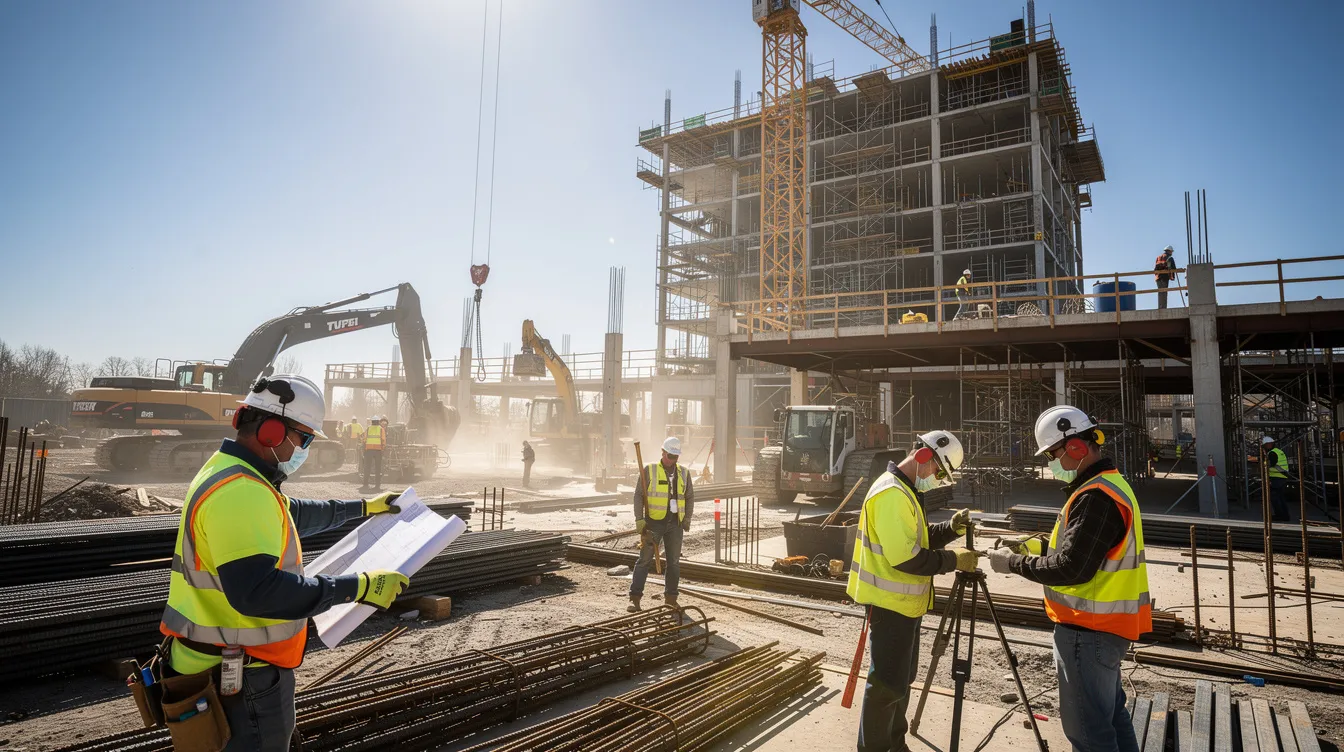
Construction safety innovation is getting more concrete for Southern California contractors. On October 5, 2026, ABC National released its sixth annual construction technology report, this year focused on health and safety technology and innovation. For contractors across Los Angeles, Orange County, the Inland Empire, Ventura County, and surrounding markets, the practical question is not whether these tools exist. It is which technologies are worth testing on the next active jobsite, how they fit existing safety programs, and how to evaluate results without overpromising what technology can do on its own.
ABC National’s new report highlights technologies and practices contractors are using to address safety challenges, including wearables, AI-powered risk detection, environmental monitoring, connected jobsite systems, and worker well-being measures.
That matters in Southern California because contractors here often manage heat exposure, dense multi-trade work areas, large commercial sites, and layered compliance obligations at the same time. New tools may help, but only if they match a defined risk, are piloted carefully, and integrate into the field processes crews already use.
One reasonable takeaway from ABC National’s release is that contractors have more safety-technology options to evaluate than they did a few years ago. That does not mean every contractor needs to deploy every category at once, and it does not mean technology replaces supervision, training, or required controls.
A practical reading for Southern California contractors is to sort these technologies by jobsite problem:
Southern California contractors do not need inflated statistics to understand the pressure points. Outdoor work in hot conditions, high-activity jobsites, and tightly sequenced commercial schedules can increase the importance of early hazard communication and heat-illness prevention. NIOSH notes that environmental conditions, hydration, clothing, and individual factors affect heat stress in construction, and recommends controls such as acclimatization, heat-stress assessment, hydration, and engineering or work-practice measures.
California also adds a live compliance dimension. Cal/OSHA’s outdoor heat standard requires high-heat procedures at or above 95°F for outdoor work, and the state’s indoor heat rule generally applies in many workplaces when the indoor temperature reaches 82°F. That does not make technology a legal substitute for compliance. It makes technology a possible support tool inside a broader prevention program.
Instead of asking which product is most impressive, ask which risk on one active jobsite is causing the most friction right now. That could be heat exposure, slow emergency communication across a spread-out site, repeated near misses around equipment movement, or poor visibility into changing field conditions.
Then use a structured pilot:
This keeps construction safety innovation tied to a measurable decision rather than a general interest in new technology.
Wearable construction technology remains one of the most visible parts of the current safety-tech conversation. NIOSH says construction wearables can include items such as clothing, watches, helmets, and eyewear, and can support functions including proximity detection, physiological monitoring, environmental sensing, and exoskeleton-assisted reduction of mechanical stress.
For Southern California contractors, the strongest early use cases are usually practical ones:
At the same time, contractors should keep expectations realistic. NIOSH’s wearable guidance is about emerging and developing uses, not a blanket guarantee of reduced injury rates on every project. Comfort, battery life, device durability, PPE compatibility, and worker trust can all determine whether a pilot succeeds.
It is also wise to treat privacy and retention rules as a governance issue from day one. Before rolling out wearables or location-sensitive tools, contractors should decide what data to collect, who can access it, how long to retain it, and whether the tool is used for safety response, aggregated trend review, or both. California employers should review project-specific privacy and labor questions with qualified counsel before deployment.
The same principle applies to AI and connected-jobsite tools: focus on the field problem, not the buzzword. ABC National’s release points to AI-powered risk detection and connected jobsite solutions as part of the broader safety-technology discussion. On a real project, that might mean computer vision that flags missing PPE in a defined area, systems that escalate urgent alerts to supervisors faster, or integrated monitoring that gives safety leaders a clearer picture of changing conditions.
These systems are most useful when they improve prevention and coordination. They are less useful when they create a second dashboard nobody checks or flood supervisors with low-value alerts.
Before testing connected systems, contractors should work through a short governance checklist:
| Question | Why It Matters |
|---|---|
| What exact risk is the system supposed to address? | Keeps the pilot tied to a real field need |
| Who receives alerts, and how fast must they act? | Prevents response gaps when a tool flags a hazard |
| How does the tool fit current communication workflows? | Reduces the chance that critical alerts are missed |
| How often does the system generate false positives? | Helps avoid alert fatigue and loss of trust |
| What data is being stored, and for how long? | Supports stronger governance and clearer worker communication |
For related background, ABC SoCal already has a published article on construction site safety innovations. This article narrows the focus by helping readers decide what to test first after ABC National’s October 5, 2026 report.
One of the most useful parts of the current conversation is that it connects physical safety with broader worker well-being. NIOSH’s Total Worker Health framework focuses on improving workers’ safety, health, and well-being together rather than treating them as separate tracks.
That matters in construction because heat, fatigue, stress, sleep disruption, and substance-use risk can all affect safe decision-making. NIOSH also notes that rates of overdose, binge drinking, and suicide are higher in some occupations, including construction, which is one reason mental-health support belongs in serious safety planning rather than on a separate island.
Technology can support that effort, but not replace fundamentals. NIOSH heat guidance still points employers back to core measures such as hydration, acclimatization, work-practice controls, engineering controls, heat-stress assessment, and medical monitoring, as appropriate. A helpful article for the broader workforce side of that discussion is mental health steps for construction workers.
OSHA recommends that employers train and drill workers on emergency communication methods and procedures. That is an important reminder for any safety-tech rollout. If a new system generates an alert, the crew still needs to know who responds, what escalation path applies, and what backup method to use if the tool fails, loses power, or doesn’t reach the right person.
In other words, a wearable alert, camera notification, or environmental alarm is only as useful as the response process behind it. Contractors testing new tools should update emergency drills, supervisor protocols, and toolbox talks so the technology supports field execution instead of complicating it.
Any Southern California pilot involving physiological, biometric, location, or camera-based monitoring should include an internal review of safety responsibilities, privacy questions, labor implications, and recordkeeping practices before rollout. That is a prudent implementation step, not a claim that every technology deployment triggers the same legal requirement.
Contractors should also keep the article’s core distinction in mind: this is about evaluating construction safety innovation, not shifting responsibility from leadership to software. Written heat-illness procedures, supervision, training, communication, and documented response plans remain essential whether a contractor deploys one connected tool or none.
ABC National’s October 5, 2026 report is best treated as a decision prompt, not a mandate to buy more software. For Southern California contractors, the next step is to identify one high-friction safety risk on the next active jobsite and test whether a specific technology improves prevention, communication, or response under real conditions.
If your company is evaluating how these tools fit into a broader safety program, ABC SoCal’s published resources on wearables, site safety innovation, and the chapter’s safety newsletter can help frame the discussion. The best first move is not a full digital overhaul. It is a focused pilot with a clear risk, a clear owner, and a clear way to judge whether the tool helps your crews work more safely.
Source note: This article is based primarily on ABC National’s October 5, 2026 news release, “ABC Report: Proactive Safety Technology Protects Workers, Jobsites”, with supplementary guidance from NIOSH, OSHA, and Cal/OSHA.






