The May 6, 2026, ABC Harris Poll didn’t survey California—but its findings on nonunion construction workers in six battleground states carry direct implications for every merit shop contractor bidding public work in Los Angeles, Orange, Riverside, San Bernardino, and Ventura Counties. Here’s why the national numbers matter in the state with the most aggressive labor-exclusive procurement policies.
Nonunion construction workers—also called merit shop or open shop workers—are those who negotiate wages, benefits, and working conditions directly with their employers rather than through collective bargaining agreements mediated by union representatives. This contrasts with workers on union construction jobs who are typically dispatched from hiring halls and adhere to standardized union scales.

Approximately 90% of construction workers in the United States are non-union, reflecting a significant preference for merit-based employment in the construction industry. This majority status aligns with the 76%–98% share of the nonunion electorate reported in the May 2026 Harris Poll states. Union workers often receive comprehensive benefits, including health insurance and pension plans, which are typically funded by employers, whereas non-union workers may receive benefits that vary significantly and may need to secure their own coverage. However, non-union workers have the flexibility to negotiate their own wages, which can vary widely depending on skills, local market conditions, and individual negotiating ability.
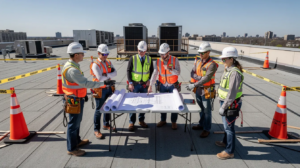
In Southern California, nonunion construction workers make up the core workforce delivering commercial buildings, warehouses, infrastructure, and LA 2028 Olympics-related construction projects. Typical roles include:
These professionals are employed by merit shop firms throughout Los Angeles and surrounding counties.
ABC National commissioned The Harris Poll in early 2026 to survey construction workers in six presidential battleground states—Arizona, Georgia, Michigan, North Carolina, Pennsylvania, and Wisconsin—about union status, political views, and federal construction policy. The poll results were released publicly on May 6, 2026, and are being used throughout the contracting community and political sphere to understand the construction workforce electorate.
Core findings from the survey:
While the poll did not include California, the national merit shop movement is using these findings as a benchmark to understand how the broader workforce views labor-exclusive contracting across private industry and the public sector.
Both union and nonunion workers in the surveyed states share significant common ground on how construction projects should be awarded. The specific percentages reveal an overwhelming majority favoring open competition: 83% of non-union workers and 73% of unionized workers agreed that federal contracts should be awarded on the basis of best value, not on whether a contractor is union or non-union.
This runs directly counter to federal and state policies that push mandatory project labor agreements, which effectively steer work toward union jobs and sideline nonunion construction workers. The data reinforce the finding that construction workers prefer merit-based selection. Contractors hiring nonunion workers can negotiate wages and benefits directly, often resulting in more competitive pricing for tight project budgets—a point the workforce clearly values.
Safety data remain contested: union job sites generally have 40% fewer safety violations and lower injury rates than nonunion sites, though safety outcomes at nonunion sites may vary by contractor. However, ABC members counter with OSHA certifications and training investments that demonstrate commitment to worker safety regardless of union status.
California’s construction industry operates under the most union-favorable regulatory and political framework in the country, even though California was not part of the Harris Poll sample. The state’s exposure to project labor agreements on state, county, city, and school district construction projects far exceeds that of contractors in Arizona, Georgia, Michigan, North Carolina, Pennsylvania, and Wisconsin.
The Skilled and Trained Workforce mandate serves as a PLA proxy, effectively excluding many merit shop construction companies by requiring a high percentage of state-approved apprenticeship graduates affiliated with union or union-like programs. Additional California pressures include:
For Southern California merit shop contractors, the poll’s message—that nonunion workers form the majority voice and favor fair competition—is a powerful counterweight to narratives claiming California workers universally support labor-exclusive procurement.
Project labor agreements often require all contractors, including nonunion firms, to follow union rules and hire through union halls, which can disadvantage the majority of construction workers who are nonunion. In California, these pre-hire agreements typically mandate adherence to union work rules, hiring through hiring halls, and payment into union trust funds—even for qualified contractors operating merit shop firms.
Prevailing wage laws set minimum pay and fringe rates on public works projects for both union and nonunion workers, but do not inherently require union membership. The Skilled and Trained Workforce requirements for certain public construction projects mandate that a high percentage of journey-level workers be graduates of state-approved apprenticeship programs. The lack of standardized apprenticeship and training programs in nonunion work can lead to variable worker expertise, creating compliance challenges.
Together, these policies create a de facto union-preference system that reduces merit-shop access to public construction projects across Los Angeles, Orange, Riverside, San Bernardino, and Ventura Counties. ABC SoCal reports that over 70% of major SoCal public bids in 2025 included such barriers.
During the 2024 federal election cycle, construction workers—especially nonunion construction workers—were widely recognized as a critical voting bloc in swing states. ABC president Michael Bellaman has publicly framed continued federal-level PLA mandates as politically risky because they alienate the same nonunion workforce that contributed strongly to Republican gains under President Donald Trump’s administration.
ABC analysis estimates that eliminating federal PLA mandates could save taxpayers approximately $10 billion annually by allowing both union and nonunion contractors to compete on an equal footing. The polling shows that both union jobs and non-union workers favor best-value procurement, undercutting claims that the construction workforce uniformly supports PLA mandates. ABC Carolinas advocates for strict enforcement of labor law, tax regulations, and safety requirements to protect nonunion workers and ensure fair competition.
This national message empowers ABC chapters like ABC Southern California to argue that California is out of step with workforce consensus when it expands labor-exclusive rules—a critical point for the 2026 midterms and the Trump administration’s infrastructure policy debates.
The stakes for Southern California contractors and construction workers between now and the 2028 Los Angeles Olympics are immense. The LA 2028 infrastructure pipeline includes $1.8 billion for venue construction, along with ancillary rail extensions, airport upgrades at LAX, SoFi Stadium-area developments, and freeway interchanges.
AB 5 imposes stricter tests for treating workers as independent contractors, forcing specialty subcontractors to reclassify workers as employees and inflating costs by 20%–30%. Merit shop construction companies have had to adjust hiring models to stay compliant. Nonunion projects are statistically 21% more likely to experience delays due to higher turnover and potential labor shortages, making workforce development critical. Nonunion job sites may experience up to 15% lower productivity due to a lack of formal apprenticeship training compared with union sites—a gap that ABC’s structured apprenticeships directly address.
Project types requiring close monitoring for PLA or skilled-and-trained clauses include:
Safety standards on nonunion sites are often less rigorous, increasing the likelihood of OSHA violations compared to unionized job sites—making ABC SoCal’s safety training programs essential for competitive bidding.
ABC SoCal contractors can frame themselves as aligned with the majority of the national construction workforce—nonunion workers who prefer fair competition and merit-based selection over exclusionary requirements or forced membership. The merit shop sector is associated with lower overall project costs, enabling more public and private projects to move forward and creating additional jobs at affordable prices despite high material prices and other major headwinds such as office vacancies.
Hiring nonunion workers often results in lower initial labor costs but can lead to challenges like higher turnover and potential skill gaps. The employment relationship in merit shop settings allows workers to choose their job sites and contractors, providing greater control over career paths. In the merit shop model, advancement opportunities are often based on performance and productivity rather than seniority, allowing for potentially faster career progression—careers based on skill development and new skills acquisition.
When speaking with public owners and elected officials, cite the 83%/73% support for best-value contracting to counter claims that workers “want” PLAs on all large construction projects. Showing officials that nonunion construction workers are the dominant voting bloc puts pressure on them to justify California’s aggressive stance on PLAs.
ABC Southern California is a nonprofit merit-shop trade association representing nonunion construction workers and contractors across Orange, Riverside, San Bernardino, Los Angeles, and Ventura Counties. Core services include apprenticeship programs and craft training (electrical, plumbing, sheet metal, low voltage), safety education (OSHA 10/30, EM 385), and continuing education for project managers.

Non-union workers can access formal training and credentials through ABC-affiliated apprenticeship and craft training programs, community colleges’ trade programs, and employer-sponsored courses. Non-union apprenticeships combine paid on-the-job training with classroom instruction, allowing apprentices to earn competitive wages from day one while working towards journey-level credentials. In 2022, Associated Builders and Contractors invested approximately $1.6 billion in workforce development, with around 1.3 million attendees participating in apprenticeships, craft training, and safety programs.
Many non-union construction workers can earn competitive wages and access comprehensive benefits packages, although availability varies by contractor. ABC SoCal helps members navigate prevailing wage compliance, DAS requirements, and questions about the Skilled and Trained Workforce on complex public projects, while connecting workers to state-recognized formal apprenticeship programs.
Policy fights over PLAs, prevailing wage expansion, and Skilled and Trained Workforce rules are long-term, multi-front campaigns requiring coordinated advocacy. ABC of California serves as the statewide coalition engaging in legislative and regulatory advocacy in Sacramento on behalf of nonunion construction workers and merit shop contractors, fighting for immediate and ongoing regulatory relief.
ABC PAC supports candidates and ballot measures that promote an open, competitive landscape and oppose labor-exclusive procurement that limits nonunion construction jobs. The Free Enterprise Alliance produces public education campaigns, research, and grassroots outreach to protect free and open competition in the construction industry. Together, this infrastructure helps construction companies choose advocacy pathways that deliver long-lasting results for the industry, building across rapidly evolving technologies and specialized skills development.
Through ABC SoCal membership, contractors gain access to this layered advocacy infrastructure, turning Harris Poll data and project experiences into political influence ahead of the 2026 midterms—demonstrating immense value for worker choice, eliminating PLA mandates, and supporting productive means to attract talent and address the retiring workforce.
For owners, estimators, project managers, and labor compliance officers at merit shop firms bidding on public and private construction projects:
This approach addresses major headwinds, including immigration enforcement pressures, trade-specific license requirements, and industry-driven multiskilling needs across job sites. Union construction workers typically have standardized wages set through collective bargaining agreements, while non-union pay reflects their own rates based on negotiated hourly rates—transparency that supports high-quality projects while helping firms maintain market competitiveness. Nonunion construction workers make up nearly 90% of the U.S. construction workforce, according to Bureau of Labor Statistics data, highlighting their significant role in local economies and their ability to save taxpayers money on public projects.
The timeline is critical: the Harris Poll was released on May 6, 2026; midterm elections will shape federal policy on PLAs, Davis-Bacon, and federal procurement rules through at least 2028; California’s legislative cycle continues to layer rules on the construction industry. Whether you’re a big company or specialty subcontractor, engagement matters now.
Contractors, subcontractors, suppliers, and industry partners should join ABC Southern California as members and:
Individual nonunion workers and supervisors should consider sharing their experiences—with consent—for messaging that highlights the real workforce behind merit-shop construction projects. Both those who belong to a union and those who don’t have a stake in ensuring fair competition.
Treat advocacy as a core business function in California’s construction industry, on par with safety, estimating, and labor compliance. ABC Southern California is your platform for translating the Harris Poll’s national data into local political influence.
While the poll did not survey California workers, it captures national construction industry sentiment in competitive states and shows that nonunion workers dominate the workforce and favor open competition. This evidence demonstrates that California’s labor-exclusive policies are out of step with the broader industry, giving merit shop advocates powerful data points when engaging elected officials and public owners who claim union labor preferences reflect workforce preferences.
Yes, in many cases, California public works projects pay prevailing wage without requiring a project labor agreement. However, agencies can choose to impose PLAs on specific projects. Nonunion merit shop contractors should review bid documents carefully and work with ABC SoCal to identify PLA mandates where possible. The key distinction is that prevailing wage sets compensation floors, while PLAs impose union rules on the employment relationship regardless of contractor status.
Skilled and Trained Workforce requirements mandate that a certain percentage of journey-level workers be graduates of approved apprenticeship programs, potentially disadvantaging nonunion contractors whose workforce has extensive experience but lacks those specific credentials. ABC SoCal can help members understand compliance thresholds, identify qualifying training pathways, and develop strategies to meet requirements without abandoning merit-based cultural values.
Workers can participate in ABC SoCal training and apprenticeship programs, stay informed on local policy debates affecting union dues and union members, share their stories with the association, and vote in line with their preferences for merit-based contracting. Engaging with ABC SoCal’s advocacy efforts amplifies the voice of nonunion workers in Sacramento and Washington.
Contact ABC SoCal for membership information, attend an upcoming safety or apprenticeship orientation, join a government affairs update session, and sign up for email alerts on PLA, prevailing wage, and Skilled and Trained Workforce developments affecting Southern California construction projects. Your participation strengthens the collective voice advocating for fair access to public work.