The Occupational Safety and Health Administration (OSHA) is responsible for assuring safe and healthy working conditions through established standards, education, training, and assistance. This article is designed specifically for Southern California contractors and construction professionals. Here, we list and explain the top OSHA violations in construction—such as fall protection, ladder safety, scaffolding, hazard communication, eye and face protection, and machine guarding—why they matter, and how understanding these violations is critical for both business survival and worker safety.
Top OSHA Violations in Construction:
Falls, ladders, scaffolds, hazard communication, eye and face protection, and machine guarding consistently rank among the most-cited violations on construction sites. These hazards not only lead to costly citations but also put workers at serious risk of injury or death. For Southern California contractors, staying informed and compliant is essential to avoid penalties, maintain project schedules, and protect your workforce.
| Violation Type | Number of Citations (2025) | Key Issue |
|---|---|---|
| Fall Protection | 5,914 | Failure to provide guardrails, safety nets, or personal fall arrest systems |
| Ladder Safety | 2,405 | Improper ladder use and placement |
| Hazard Communication | 2,546 | Lack of proper labeling and training regarding chemical hazards |
| Scaffolding | 1,905 | Improper assembly, missing guardrails, lack of stability |
| Eye and Face Protection | 1,665 | Insufficient provision or use of protective equipment |
| Machine Guarding | 1,239 | Unguarded machinery creating potential hazards |
Picture a mixed-use project in downtown Los Angeles. A framer working on an unprotected roof edge takes a fall. Within hours, an OSHA inspector arrives. The project grinds to a halt while citations are issued, and the general contractor faces penalties exceeding $16,000 per serious violation.
The Occupational Safety and Health Administration exists to protect construction workers through enforceable standards and regular inspections. With construction consistently ranking among the most cited industries, understanding these violations isn’t optional—it’s essential for survival.
The numbers tell the story: serious violations now carry penalties of $16,550 each, while willful violations can reach $165,514. But direct fines represent only part of the damage. Indirect costs—lost productivity, overtime to recover schedule, spiking insurance premiums, and damaged prequalification scores—often multiply the financial impact by four to ten times.
For Southern California contractors, repeat violations can disqualify firms from public works projects and affect bonding capacity. The construction industry operates on tight margins where a single serious incident can reshape a company’s future.
OSHA releases its preliminary list of frequently cited violations annually, with the fiscal year running from October 1 through September 30. The same core hazards have dominated this list for over a decade:
While some standards carry “1910” general industry designations, they frequently apply to construction environments, including fabrication shops, prefab yards, and equipment maintenance operations.
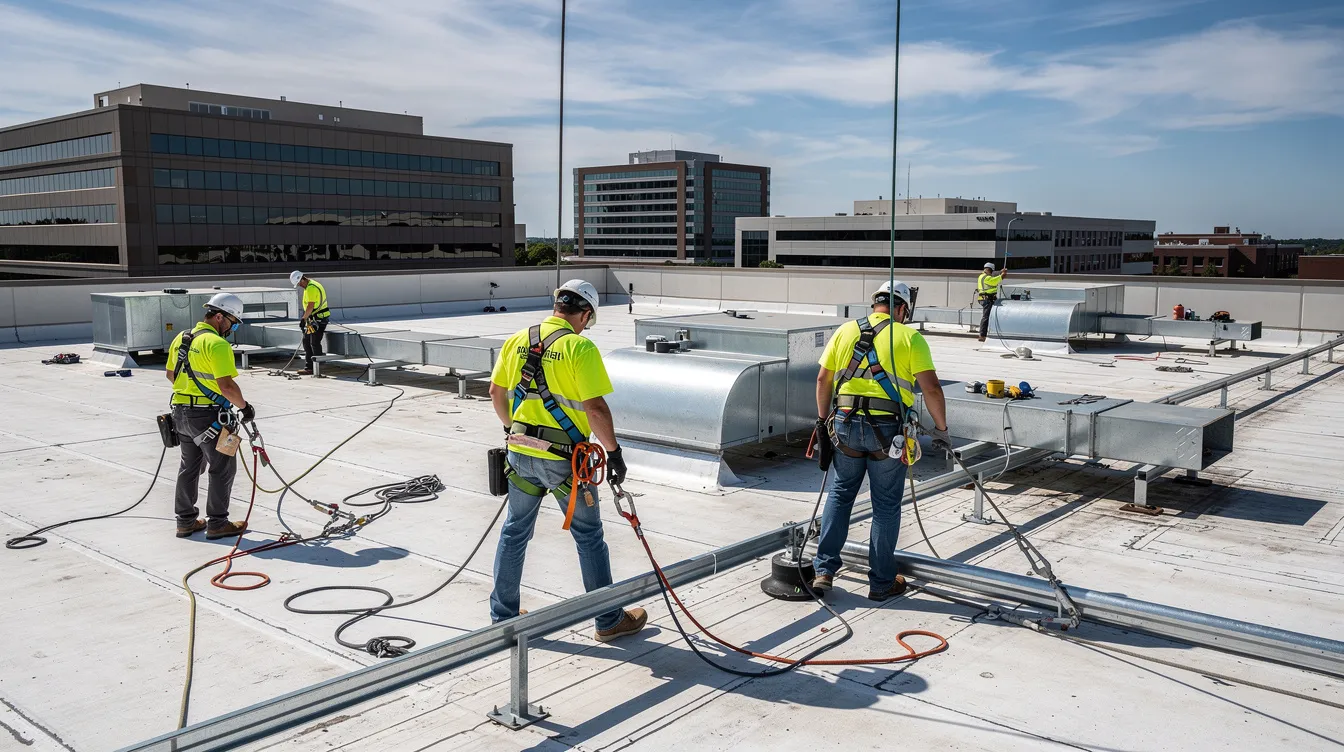
Definition: Fall protection is the most frequently cited workplace safety violation in construction, with thousands of violations reported each year. Fall protection violations are the most frequently cited OSHA violations in construction, with 5,914 violations reported in 2025. Fall protection violations often involve failure to provide guardrails, safety nets, or personal fall arrest systems at heights over 6 feet.
A lack of proper head protection can result in serious head injuries from falls or falling objects, which is why OSHA regulations require the use of hard hats and other safety gear on construction sites.
ABC SoCal offers fall protection training and OSHA 10/30 courses that walk supervisors through real-world scenarios typical to Southern California projects.
Transition: In addition to fall protection, proper training is essential to ensure workers know how to use safety equipment effectively.
Having equipment on site means nothing if workers don’t know how to use it. Fall protection training requirements generated nearly 2,000 citations in FY 2025, exposing gaps where personal protective equipment exists but knowledge fails.
ABC SoCal’s apprenticeship safety curriculum and specialized courses help contractors satisfy and exceed these training requirements.
Transition: In addition to fall hazards, chemical exposure and communication present another major area of concern for OSHA violations.
Definition: Hazard communication violations involve failing to properly label chemicals or to maintain Safety Data Sheets (SDSs). Hazard communication violations accounted for 2,546 citations in construction, indicating a lack of proper labeling and training regarding chemical hazards.
Transition: In addition to chemical hazards, ladder safety violations are a frequent source of citations on construction sites.
Definition: Ladder safety violations resulted in 2,405 citations, highlighting the dangers associated with improper ladder use and placement. The common citation issues for ladders include failing to extend ladders 3 feet above landings and using unstable surfaces, resulting in a total of 2,405 citations.

Transition: In addition to ladder safety, scaffolding poses another major concern for OSHA violations.
Definition: Scaffolding violations are commonly related to missing guardrails, improper planking, or a lack of stability. Scaffolding violations resulted in 1,905 citations, underscoring the need for proper assembly and stability of scaffolding structures.
Transition: Beyond scaffolding, aerial lifts introduce additional elevated work hazards that require strict safety protocols.
Aerial lifts are indispensable on modern construction sites, enabling workers to safely access elevated work areas for installation, maintenance, and inspection tasks. However, operating above ground level introduces unique hazards that demand strict adherence to occupational safety protocols and OSHA regulations. Under OSHA standard 1926.453, employers must ensure that only trained and authorized employees operate aerial lifts—including boom lifts, scissor lifts, and personnel lifts.
By prioritizing aerial lift safety, construction companies can protect their workforce, reduce the risk of OSHA violations, and foster a culture of workplace safety that benefits every project.
Transition: After addressing elevated work hazards, it’s important to consider equipment-related hazards such as lockout/tagout procedures.
While primarily a general industry standard, lockout/tagout applies to construction firms during equipment maintenance, fabrication work, and shop operations. Electricians servicing energized panels and mechanics working on equipment without proper isolation create serious caught-in hazards.
Transition: In addition to energy control, respiratory hazards are a significant concern on construction sites.
Respiratory protection violations are closely tied to construction activities producing dust, fumes, and vapors. Southern California risks include silica dust from cutting concrete, welding fumes, and spray coating applications.
Prioritize engineering controls, such as wet cutting and vacuum systems, before relying on personal protective equipment. ABC SoCal offers training on silica exposure and fit-testing guidance aligned with both federal OSHA and Cal/OSHA requirements.
Transition: In addition to respiratory hazards, powered industrial trucks present another area where OSHA violations frequently occur.
Powered industrial trucks, including forklifts and telehandlers, consistently rank among the top violations with 1,826 citations in recent data. Construction scenarios involve loading materials on congested sites, rough-terrain operations, and restricted-visibility deliveries.
Establish clear PIT policies covering training, authorization, and the designated travel lanes that separate industrial trucks from workers on foot.
Transition: In addition to powered equipment, eye and face protection are essential for routine construction tasks.
Definition: Eye and face protection violations accounted for 1,665 citations, indicating insufficient provision or use of protective equipment against hazards.
Transition: Alongside personal protective equipment, machine guarding is critical in shop and fabrication environments.
Definition: Machine guarding violations resulted in 1,239 citations, underscoring the risks posed by unguarded machinery in construction environments.
Transition: Understanding why these violations persist is key to developing effective prevention strategies.
The same violations appear year after year because they connect to core construction tasks performed on every project. Systemic causes include:
Smaller Southern California contractors face additional challenges: limited in-house safety staff, complex dual regulatory environments (OSHA plus Cal/OSHA), and multi-employer worksite coordination.
OSHA’s repeated Top 10 list isn’t a mystery—it’s a roadmap. Addressing these hazards proactively delivers an outsized impact on injury reduction and cost control.
Regular safety audits and inspections are the backbone of an effective occupational safety and health program in the construction industry. These proactive reviews allow construction companies to identify potential hazards, evaluate the effectiveness of existing safety measures, and ensure ongoing compliance with OSHA regulations before violations occur.
By systematically addressing findings from audits and inspections, construction companies can eliminate hazards, strengthen safety protocols, and reduce the likelihood of OSHA citations. These practices also demonstrate a commitment to occupational safety that can improve morale, enhance reputation, and support business growth. ABC SoCal members have access to resources and templates to streamline safety audits, making it easier to maintain compliance and protect both workers and the bottom line.
A proactive safety culture integrates occupational safety and health into every project phase: preconstruction planning, daily audits, and ongoing education. ABC SoCal supports member construction companies through:
Beyond training, ABC SoCal advocates for merit shop contractors on regulatory and labor issues affecting workplace safety compliance across Southern California construction sites.
Ready to reduce OSHA citations, protect your workers, and keep projects on schedule? Contact ABC SoCal to explore membership benefits, enroll your team in required training, and access the resources your company needs to build safer.

Construction sites typically face inspection after serious incidents (falls, amputations, fatalities), worker complaints, programmed inspections targeting high-hazard industries, or follow-up visits after previous OSHA citations. Inspectors focus first on obvious “Focus Four” hazards—falls, struck-by, caught-in/between, and electrical shock—then review documentation including OSHA 300 logs, training program records, and written safety programs. Maintaining updated programs significantly improves inspection outcomes.
California operates its own state plan through Cal/OSHA, adopting federal standards as baseline but often adding stricter health provisions—particularly for heat illness prevention, silica exposure, and Injury and Illness Prevention Programs (IIPP). Southern California contractors must comply with both Cal/OSHA Title 8 regulations and applicable federal OSHA standards, with enforcement carrying higher penalties for serious violations.
OSHA expects written fall protection plans appropriate to specific sites and work, evidence of hazard assessments, selection of protective systems, training records for all exposed employees, and inspection records for fall protection equipment. Missing documentation frequently converts informal inquiries into formal citations even when equipment exists on site.
OSHA regulations require retraining when workplace conditions change, equipment changes, or evidence shows employees aren’t following previous training. Practical approaches include annual formal refreshers for key topics, weekly toolbox talks covering task-specific hazards, and additional training after any serious incident or near-miss.
Prioritize high-impact areas: fall protection, ladder safety, scaffolds, hazard communication, and basic PPE, including head protection and eye and face protection. Use association resources and templates from ABC SoCal rather than starting from scratch. Appoint working foremen as competent persons with targeted training, schedule short regular safety meetings, and leverage consultation services available through membership.